
A patient enters surgery with hope of improvement, only to experience complications. A prescribed medication causes unexpected side effects. A diagnosis takes longer than expected, and the patient’s condition worsens. These scenarios represent the reality of modern medicine: not all negative outcomes are the result of negligence.
This distinction is critical. In the United States legal system, the difference between a “bad medical outcome” and “medical malpractice” can be the difference between receiving compensation and receiving none. Understanding these differences is essential for patients considering legal action and for anyone seeking to comprehend how the American healthcare system addresses medical errors.
Quick Distinction
- Bad Outcome: An unfortunate result despite proper care following medical standards
- Medical Malpractice: Failure to follow the standard of care that directly causes harm to the patient
What is a “Bad Medical Outcome”?
A bad medical outcome is an unfortunate or adverse result of medical treatment that occurs despite the healthcare provider meeting the accepted standard of care. Even when a doctor follows best practices, uses appropriate procedures, and exercises proper judgment, medicine remains inherently uncertain. Not all risks can be eliminated, and not all patients respond the same way to treatment.
Definition: Bad Medical Outcome
An unfavorable result of medical treatment or procedure that occurs despite appropriate and competent care meeting professional standards. The provider did everything right; the outcome was simply unfortunate.
Common Examples of Bad Medical Outcomes
- Infection after surgery – Even with proper sterilization and protocol adherence, infections can develop
- Allergic reactions to medications – Despite proper administration of a necessary medication, a patient experiences disclosed adverse effects
- Disease progression – Despite timely diagnosis and appropriate treatment, the underlying condition progresses
- Rare side effects – A patient experiences a known but uncommon medication side effect
- Unsuccessful surgery – A surgical procedure is performed correctly but doesn’t achieve the hoped-for result
- Underlying health complications – A patient’s existing comorbidities cause unexpected complications during treatment
- Patient non-compliance – A patient fails to follow medical advice, resulting in poor outcomes
- Unpredictable complications – Unexpected but recognized risks during a procedure materialize
The critical element in a bad outcome is that the healthcare provider exercised appropriate judgment, followed established protocols, and met the professional standard of care—yet the result was still adverse.
What is Medical Malpractice?
Medical malpractice is fundamentally different. It occurs when a healthcare provider fails to meet the accepted standard of care, and that failure directly causes harm to the patient. The outcome is not merely bad; it is the direct result of negligence or failure to follow established medical protocols.
Definition: Medical Malpractice
When a healthcare professional, through negligent act or omission, deviates from standards in their profession, thereby causing injury or death to a patient. The provider failed to do what a competent professional would have done under similar circumstances.
Common Examples of Medical Malpractice
- Misdiagnosis – Failure to diagnose a condition that should have been identified with appropriate testing
- Surgical errors – Operating on the wrong body part, leaving surgical instruments inside a patient, or performing wrong procedure
- Medication errors – Administering the wrong medication or wrong dosage despite standard protocols
- Delayed diagnosis – Failing to order appropriate tests or recognizing symptoms that constitute a clear deviation from standard care
- Failure to follow protocol – Not adhering to established medical procedures and standards
- Lack of informed consent – Failing to inform patients of known risks before procedures
- Post-operative negligence – Inadequate follow-up care or failure to monitor post-operative complications
- Diagnostic oversights – Ignoring test results, patient symptoms, or medical history that should have prompted further investigation
In malpractice cases, the provider’s actions or omissions fall below what a reasonably competent professional would have done under similar circumstances. This is the crucial distinction.
Visual Comparison: Bad Outcome vs Malpractice

The Four Legal Elements of Medical Malpractice
To successfully prove medical malpractice in the United States, a plaintiff must establish four distinct legal elements. All four must be present and proven; missing even one element means the case fails.
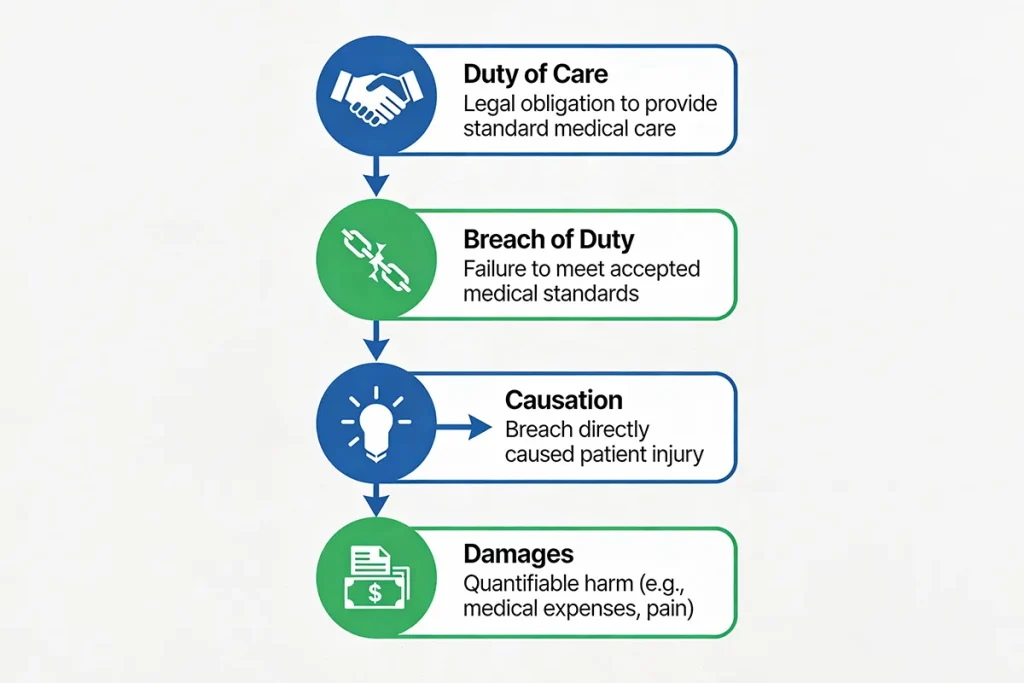
Element 1: Duty of Care
The first element requires establishing that a healthcare provider owed a legal duty to the patient. This duty arises automatically when a provider-patient relationship is established—the moment a doctor agrees to treat a patient. This duty requires the provider to:
- Exercise the degree of skill and care expected of a reasonably competent professional in their field
- Keep current with standard medical practices and developments in their specialty
- Use proper diagnostic tools and treatment protocols
- Exercise appropriate professional judgment
Element 2: Breach of Duty
The second element requires proving the provider breached this duty—meaning they failed to meet the standard of care. This is typically the most contested element in malpractice cases. The “standard of care” is defined as the level of treatment a reasonably competent healthcare provider in the same specialty would provide under similar circumstances.
To prove breach of duty, malpractice attorneys typically must present expert testimony from a qualified healthcare professional in the same field, establishing what the standard of care was and how the defendant provider failed to meet it. The expert must demonstrate that the provider’s actions fell below acceptable professional practices.
Element 3: Causation
Proving breach of duty is insufficient. The third element requires establishing causation—that the provider’s breach directly caused the patient’s injury. The plaintiff must show a direct relationship between the negligent act and the resulting harm.
This is a critical distinction. A provider might breach the standard of care, but if that breach didn’t cause the patient’s injury, malpractice hasn’t occurred. For example, if a doctor fails to order a particular test (breach of duty) but the patient’s disease would have progressed identically regardless, causation hasn’t been established.
Element 4: Damages
Finally, the patient must have suffered measurable damages—quantifiable harm that entitles them to compensation. Types of damages include:
- Economic Damages: Medical bills, lost wages, rehabilitation costs, future medical expenses
- Non-Economic Damages: Pain and suffering, emotional distress, loss of enjoyment of life, disability
- In Wrongful Death Cases: Loss of consortium, funeral expenses, lost economic support to dependents
Side-by-Side Comparison: Bad Outcome vs. Malpractice
| Aspect | Bad Medical Outcome | Medical Malpractice |
|---|---|---|
| Definition | Adverse result despite proper care and protocol adherence | Failure to meet standard of care causing harm |
| Provider Actions | Followed established protocols and best practices | Deviated from standard protocols and practices |
| Causation | Result not caused by provider’s negligence | Direct causal link between negligence and injury |
| Standard of Care | Met professional standards | Failed to meet professional standards |
| Expert Opinion | Expert testifies care was appropriate | Expert testifies provider deviated from standard care |
| Legal Claim Viability | No valid malpractice claim | Potential valid claim if all 4 elements proven |
| Compensation | Generally no compensation available through malpractice law | Patient may recover damages for injuries caused |
Real-World Scenarios Illustrating the Difference
Scenario 1: Post-Surgical Infection
Bad Outcome Example
Facts:
Patient undergoes abdominal surgery. All sterilization protocols are followed. Operating room procedures meet all standards. Post-operative care is appropriate and monitored. Despite these precautions, the patient develops a surgical site infection (which occurs in 1-3% of surgeries even with perfect technique).
Legal Determination:
Bad Outcome, Not Malpractice – The provider met the standard of care. Post-surgical infections are recognized risks despite proper protocol adherence. Expert testimony would establish that the care met professional standards.
Malpractice Example
Facts:
Patient undergoes abdominal surgery. The surgeon fails to properly sterilize the operating room or uses contaminated instruments. Standard infection prevention protocols are not followed. The patient develops a serious post-operative infection requiring additional surgeries and causing permanent damage.
Legal Determination:
Medical Malpractice – The provider failed to meet the standard of care by not following sterilization protocols. The breach directly caused the infection. Expert testimony establishes the deviation from standard practice.
Scenario 2: Diagnosis of Chest Pain
Bad Outcome Example
Facts:
Patient presents to emergency room with chest pain. Provider performs EKG, blood tests, and thorough physical examination—all normal or non-specific. Patient is reassured and discharged. Hours later, patient suffers a heart attack at home from an atypical presentation that wasn’t revealed by standard testing.
Legal Determination:
Bad Outcome, Not Malpractice – The provider followed appropriate diagnostic protocols. Some heart attacks present atypically and evade standard testing. Expert testimony establishes the care met standards.
Malpractice Example
Facts:
Patient presents with chest pain and shortness of breath. Standard protocol requires EKG and troponin testing. The provider documents the symptoms but fails to order any cardiac testing, attributing symptoms to anxiety without examination. Patient suffers a heart attack that could have been identified and treated with standard testing.
Legal Determination:
Medical Malpractice – The provider failed to follow standard protocol for chest pain evaluation. The breach (failure to test) directly caused harm (untreated myocardial infarction). Expert testimony establishes the deviation from standard care.
Scenario 3: Medication Side Effects
Bad Outcome Example
Facts:
Patient is prescribed an FDA-approved medication for a serious condition. The provider reviews the patient’s medication history and checks for interactions. Informed consent discusses known side effects. Patient experiences a rare but documented side effect that occurs in 0.1% of patients despite proper administration and monitoring.
Legal Determination:
Bad Outcome, Not Malpractice – The provider prescribed appropriate medication, checked for interactions, and obtained informed consent. The side effect, while adverse, was foreseeable and disclosed.
Malpractice Example
Facts:
Patient is prescribed a medication. The provider fails to review the patient’s history and doesn’t notice the patient is already taking a medication that creates dangerous interactions. The provider doesn’t discuss side effects with the patient. Patient suffers severe adverse effects from the dangerous drug-drug interaction that could have been prevented with standard care.
Legal Determination:
Medical Malpractice – The provider failed to review medication history and check for interactions (breach). The failure to do standard drug interaction screening directly caused the adverse outcome. Expert testimony establishes the deviation from standard prescribing practices.
Visual Reference: Three Real-World Scenarios

The Critical Role of Expert Testimony
In virtually all medical malpractice cases, expert testimony is required. An expert witness—a healthcare professional with training and experience in the same field as the defendant—must testify regarding:
- What the standard of care was – What a reasonably competent professional in that specialty would have done
- How the defendant deviated from that standard – Specific ways the provider’s care fell below acceptable practices
- How that deviation caused harm – The causal link between the breach and the patient’s injury
The expert’s role is to help the jury understand complex medical concepts and determine whether the provider’s care met professional standards. Without credible expert testimony establishing deviation from the standard of care, malpractice claims virtually always fail—even if the outcome was genuinely bad.
Practical Implications for Patients
When You Likely Have a Malpractice Case
- Provider failed to diagnose a condition that should have been identified with standard testing
- Provider didn’t follow established protocols or best practices in your specialty
- You received treatment you weren’t informed about or didn’t consent to
- Provider made a clear error (wrong medication, wrong site, retained object)
- Provider failed to respond to obvious symptoms or test results
- Expert testimony confirms deviation from standard of care
When You Likely Don’t Have a Malpractice Case
- Provider followed all established protocols and standard procedures
- A known, disclosed risk materialized despite proper care
- Expert testimony confirms the care met professional standards
- You suffered a bad outcome that wasn’t caused by provider negligence
- Your condition was difficult to diagnose despite appropriate evaluation
- The outcome was due to your failure to follow medical advice
Conclusion
The distinction between a bad medical outcome and medical malpractice is not merely semantic—it has profound legal and financial implications. A bad outcome, no matter how unfortunate, does not constitute malpractice unless the healthcare provider failed to meet the accepted standard of care, and that failure directly caused the patient’s injury.
Medical malpractice requires proving four elements: duty of care, breach of that duty, causation, and damages. All four must be established through evidence and expert testimony. Understanding this distinction is essential for patients considering legal action and for anyone seeking to comprehend how the American legal system balances accountability for medical negligence with the reality that medicine, despite best efforts, sometimes produces adverse outcomes.
If you believe you’ve experienced medical malpractice rather than simply a bad outcome, consulting with a qualified medical malpractice attorney in your state is the appropriate next step. They can evaluate your specific circumstances, review medical records, consult with medical experts, and determine whether a viable claim exists.
Disclaimer
This article provides general educational information about the distinction between bad medical outcomes and medical malpractice. It should not be construed as legal advice. Consult with a qualified medical malpractice attorney in your state for advice specific to your situation.
© 2026 lawyersformedicalmalpractice.top All rights reserved.


