
Introduction
Medical malpractice lawsuits represent a critical intersection of healthcare, law, and patient rights in the United States. When medical professionals fail to provide the standard of care expected in their field, the consequences can be catastrophic—leaving patients with permanent injuries, emotional trauma, and substantial financial burdens. Understanding the financial landscape of malpractice litigation is essential for patients considering legal action, healthcare providers managing risk, and anyone seeking to comprehend how the U.S. justice system compensates medical negligence.
The question of “what is the average payout for a malpractice lawsuit?” is deceptively simple, yet the answer reveals a complex and highly variable system. Payouts depend on numerous factors including the severity of injury, the jurisdiction where the case is filed, the type of medical error, and whether the case settles or goes to trial. In 2025-2026, the national average medical malpractice settlement stands at approximately $348,000 to $450,000, though this figure masks tremendous variation across cases and states.
This comprehensive guide explores the financial realities of medical malpractice compensation in the United States, providing data-driven insights into settlement amounts, verdict awards, state-by-state variations, and the factors that influence payout values.
National Average Medical Malpractice Payouts
Current National Averages (2025-2026)
According to the National Practitioner Data Bank (NPDB)—the federal repository for malpractice claims data—the average medical malpractice settlement in the United States has fluctuated in recent years:
- 2024-2025: $348,065 to $450,000 per claim
- 2026 Estimate: $423,000 to $425,000
- Median Settlement: $250,000 to $750,000
It’s critical to distinguish between the average and the median. The average is mathematically computed by dividing total payouts by the number of cases, making it vulnerable to distortion by extremely large verdicts. The median—the middle point of all settlements—often better reflects what a typical claimant might expect. In medical malpractice cases, the median of approximately $250,000 to $750,000 is generally more representative of actual settlements than the inflated average.
Settlement vs. Trial Outcomes
One of the most significant distinctions in medical malpractice compensation involves the pathway a case takes:
Settlement Outcomes:
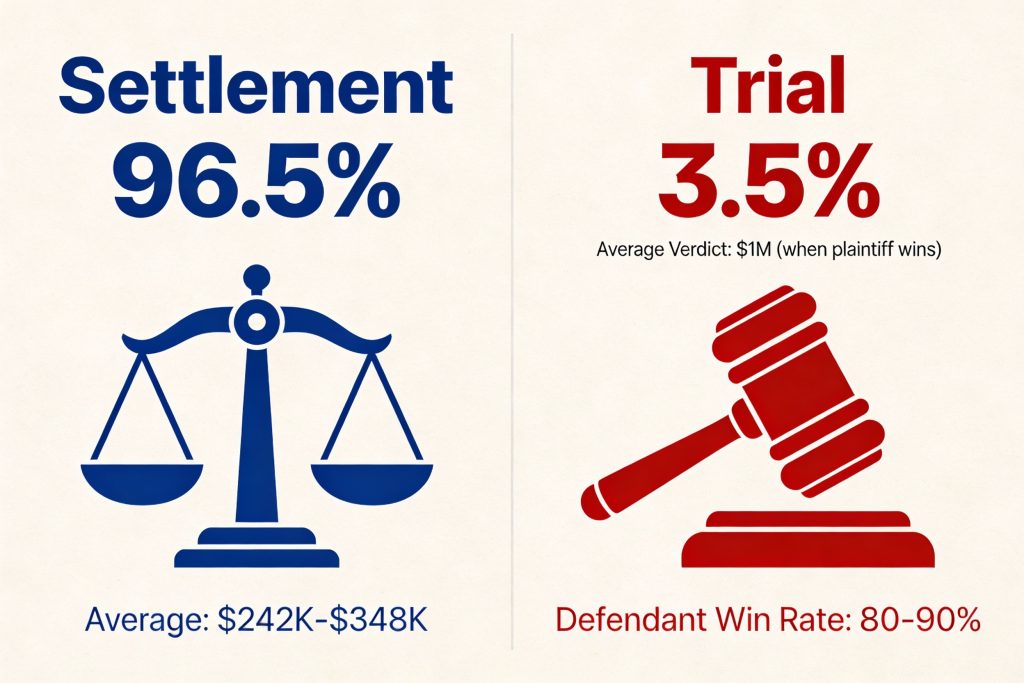
- 96.5% of medical malpractice cases are resolved through settlement
- Average settlement payout: $242,000 to $348,000
- Median settlement: $250,000
Trial Verdicts:
- Only 3.5% of cases proceed to trial
- Average jury verdict (when plaintiff wins): approximately $1,000,000
- However, defendants win 80-90% of cases that go to trial
This disparity reflects the inherent risks of litigation. While jury awards can be substantial, the high success rate for defendants at trial makes settlement a more predictable outcome for plaintiffs. Insurance companies and defendants typically prefer the certainty of a negotiated settlement to the unpredictability of jury judgment.
Payouts by Type of Injury
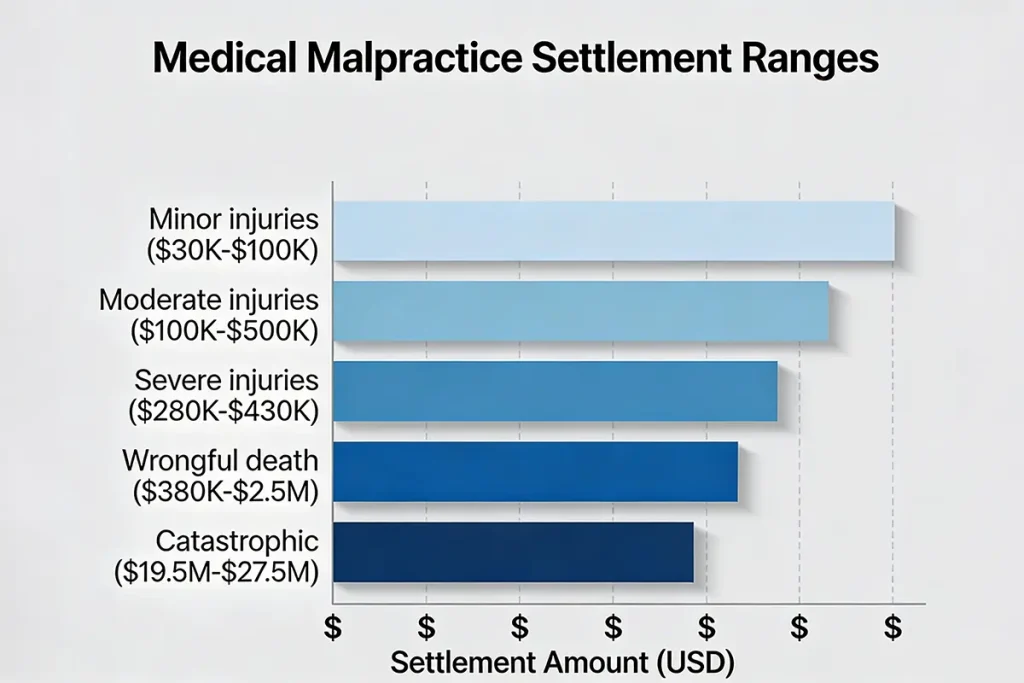
Medical malpractice settlements vary dramatically based on the nature and severity of the injury sustained. Understanding these categories helps contextualize the “average” figure:
Minor Injuries
For cases involving temporary harm without lasting consequences:
- Range: $30,000 to $100,000
- Examples: Short-term complications, brief hospitalization, medication errors without permanent effects
- Considerations: These cases often settle quickly, with compensation covering medical expenses and minimal pain and suffering
Moderate to Significant Injuries
Cases where patients recover but require ongoing treatment or experience temporary disability:
- Range: $100,000 to $500,000
- Examples: Prolonged recovery periods, temporary loss of function, surgeries required due to initial error
- Considerations: Compensation typically covers extended medical bills, lost wages during recovery, and pain and suffering
Severe Permanent Injuries
Cases involving permanent disability, loss of limbs, or chronic conditions:
- Range: $280,000 to $430,000 (general range)
- Examples: Spinal cord injuries, permanent neurological damage, loss of professional capacity
- Considerations: These settlements account for lifetime medical care, lost earning capacity, permanent disability adjustments, and substantial pain and suffering compensation
Wrongful Death
When medical malpractice results in patient death:
- Average Payout: $380,300
- Range: $500,000 to $2,500,000 (most cases in this range)
- Factors Considered: Deceased’s lost lifetime earnings, economic support lost to dependents, loss of consortium, emotional devastation to family
- Historical Context: Wrongful death cases tend to receive higher compensation, reflecting the finality and gravity of the outcome
Catastrophic Injuries
The most severe outcomes, typically involving complete disability or near-death experiences:
- Range: $19.5 million to $27.5 million
- Examples: Birth injuries resulting in cerebral palsy, anesthesia errors during surgery, retained surgical objects leading to organ failure
- Frequency: Over 50% of the largest settlements involved improper performance of procedures or failure to diagnose critical conditions
Common Malpractice Cases and Typical Payouts
Certain types of medical errors are particularly common in litigation, each with characteristic payout ranges:
Birth Injury Cases
- Range: $250,000 to $20,000,000+
- Most Common Errors: Failure to detect fetal distress, improper use of forceps, delayed cesarean sections
- Payout Drivers: Severity of cerebral palsy or neurological damage; lifetime care needs for severely affected children can justify multi-million dollar awards
Misdiagnosis Cases
- Range: $1.2 million (stroke misdiagnosis example) to $5 million+
- Most Common Types: Cancer misdiagnosis, heart attack overlooked, appendicitis confused with gastroenteritis
- Payout Drivers: Duration of delayed treatment, progression of underlying condition during diagnostic delay, permanent complications from late-stage disease
Surgical Errors
- Range: $300,000 to $10 million+
- Examples: Wrong-site surgery, retained surgical instruments, nerve damage during operation
- Payout Drivers: Severity of complication, need for corrective surgery, permanent disability resulting from error
Medication Errors
- Range: $50,000 to $2 million
- Examples: Wrong dosage, drug interactions, allergic reactions not caught despite chart documentation
- Payout Drivers: Severity of adverse reaction, whether error was clearly documented in records
Failure to Treat/Delayed Treatment
- Range: $200,000 to $5 million+
- Examples: Ignored patient complaints, failure to follow up on test results, inadequate follow-up care
- Payout Drivers: Extent of harm that would have been prevented by timely treatment, permanence of resulting condition
Medical Malpractice Payouts by State (2024-2025)
State-by-state variation in medical malpractice payouts is substantial, driven by differences in state tort law, damage caps, jury attitudes, and healthcare system characteristics.
Highest Average Payouts by State
| State | Average Payout per Claim | Total Payouts | Number of Claims |
|---|---|---|---|
| South Dakota | $1,160,000 | $19.76M | 17 |
| District of Columbia | $1,120,000 | $28.11M | 25 |
| Wyoming | $2,373,750 | Variable | 4 |
| Wisconsin | $860,000 | $52.34M | 61 |
| Georgia | $680,000 | $217.81M | 322 |
| Connecticut | $660,000 | $88.86M | 134 |
| Illinois | $685,000 | $312.76M | 477 |
| Minnesota | $1,343,020 | $21.77M | 24 (in some years) |
Largest Total Payouts by State
| State | Total Payouts | Number of Claims | Average per Claim |
|---|---|---|---|
| New York | $595.42M | 1,284 | $464,000 |
| Pennsylvania | $557.62M | 1,070 | $521,000 |
| Florida | $389.38M | 1,167 | $334,000 |
| Illinois | $312.76M | 477 | $686,000 |
| New Jersey | $348.69M | 667 | $523,000 |
| California | $341.62M | 1,074 | $318,000 |
| Maryland | $123.63M | 226 | $547,000 |
Lowest Average Payouts by State
| State | Average Payout per Claim | Total Payouts | Number of Claims |
|---|---|---|---|
| Vermont | $100,000 | $2.86M | 28 |
| North Dakota | $160,000 | $1.28M | 8 |
| Wyoming | $160,000 (for larger sample) | $1.59M | 10 |
| Texas | $221,000 | $159.12M | 631 |
| Kansas | $247,000 | $47.95M | 198 |
| Louisiana | $231,000 | $80.20M | 231 |
| Indiana | $235,000 | $75.19M | 278 |
Why Such Wide Variation?
The dramatic differences between states reflects several key factors:
Damage Caps: States with statutory limits on non-economic damages (pain and suffering) show lower average payouts. California’s MICRA law caps non-economic damages at $350,000, contributing to its average of approximately $318,000. Texas’s damage caps result in similarly restrained payouts around $221,000.
Jury Attitudes: States without damage caps and with plaintiff-friendly juries tend to award higher damages. Illinois and Connecticut juries are known for substantial awards in medical negligence cases.
Healthcare Density: States with major medical centers and complex cases often see higher payouts. New York and Pennsylvania, with dense healthcare infrastructure and large populations, generate high total payouts, though their per-case averages reflect the mix of case severity.
Tort Reform: States with recent tort reform legislation limiting liability or requiring expert testimony often see reduced payouts. These restrictions directly lower settlement amounts as defendants’ perceived risk decreases.
Population Size and Case Volume: Smaller states sometimes report higher average payouts because severe cases represent a larger proportion of their total caseload. South Dakota and Wyoming’s high averages reflect fewer total claims but significant individual cases.
Factors That Influence Malpractice Payout Amounts
The variation in medical malpractice payouts isn’t random. Specific factors demonstrably influence settlement and verdict amounts:
1. Severity and Permanence of Injury
The single most important determinant of payout amount is the degree of harm sustained:
- Temporary vs. Permanent: Injuries that resolve completely command lower settlements than permanent disabilities. A surgical error resulting in a 6-week recovery receives far less compensation than one causing permanent nerve damage.
- Functional Impairment: Assessment of the patient’s ability to work and engage in daily activities directly correlates to compensation. A surgeon’s error causing hand tremor might preclude a surgeon from practicing but wouldn’t affect other professions.
- Lifetime vs. Temporary Costs: Courts and juries calculate future medical expenses, medications, therapy, and assistance needs. A 30-year-old with a permanent condition will require decades of care, justifying substantially higher awards than a 70-year-old with similar injuries.
2. Strength of Evidence of Negligence
How clearly the case demonstrates deviation from medical standards affects settlement value:
- Clear Deviation: When expert testimony definitively establishes that the defendant’s actions fell below the standard of care expected in that specialty, settlements increase. Retained surgical objects or operations on the wrong body part represent near-indefensible cases.
- Disputed Standard: If the defendant can argue their actions were within accepted practice standards, even if less optimal than alternatives, settlement value decreases substantially.
- Documentation: Clear medical records supporting the negligence claim increase valuation. Conversely, incomplete or altered records can harm plaintiff cases significantly.
3. Economic Damages (Objective Losses)
These quantifiable losses form the foundation of most settlements:
- Medical Expenses: Past and future surgery, hospitalization, medication, therapy, medical devices, and home modifications
- Lost Wages: Calculation of lost income during recovery period and permanent loss of earning capacity if the injury prevents return to work
- Care Costs: Cost of hiring attendant care, nursing, or assistance with activities of daily living
- Travel and Related Expenses: Transportation for ongoing medical treatment and associated costs
These damages are often the largest component of awards, particularly in cases with permanent injury.
4. Non-Economic Damages (Subjective Losses)
These damages for pain, suffering, and quality of life impacts face legal limits in many states:
- Pain and Suffering: Compensation for physical pain experienced and ongoing discomfort
- Emotional Distress: Psychological trauma, anxiety, depression, and reduced quality of life
- Loss of Enjoyment: Inability to pursue hobbies, sports, or activities previously enjoyed
- Loss of Consortium: In cases involving spouses or family members, compensation for loss of companionship and support
In states without damage caps, juries can award substantial non-economic damages. In states with caps (like California’s $350,000 limit), these awards are artificially constrained.
5. Defendant’s Insurance Coverage
The financial resources available to pay claims influence settlement negotiations:
- Policy Limits: Most healthcare providers maintain malpractice insurance with defined limits. If a case would justify $2 million in damages but the policy limit is $1 million, settlement typically caps at the insurance limit.
- Umbrella Coverage: Large healthcare systems often carry umbrella policies providing additional coverage beyond standard malpractice insurance
- Defendant’s Personal Assets: While rarely pursued, in egregious cases, defendants’ personal assets might be accessed
6. Jurisdiction and Venue
Where a case is filed dramatically affects outcomes:
- Urban vs. Rural Juries: Urban juries tend to award more than rural ones, reflecting different attitudes toward healthcare and corporate defendants
- State Law Variations: Different states have different standards for proving negligence, statute of limitations, and damage calculations
- Specific Venues: Within states, certain counties are known as “plaintiff-friendly” or “defendant-friendly,” affecting settlement calculations
7. Defendant’s Culpability and Credibility
How the defendant’s conduct appears to jurors influences jury awards:
- Gross Negligence: Egregious errors (operating while intoxicated, flagrant violation of protocol) result in higher awards
- Credibility: Defendants perceived as dishonest or evasive trigger larger jury awards than those who take responsibility and testify credibly
- Pattern of Neglect: Evidence of repeated similar errors or patient complaints against a particular provider increases awards
8. Quality of Legal Representation
Both plaintiff and defense attorneys significantly influence outcomes:
- Expert Witnesses: Compelling expert testimony establishing negligence increases settlements; weak expert support decreases valuation
- Evidence Presentation: How effectively lawyers present complex medical information to juries affects verdicts
- Negotiation Skills: Settlement amounts often reflect the negotiating ability and credibility of each side’s counsel
9. Life Expectancy and Age
The plaintiff’s age and expected lifespan directly affect lifetime damages calculations:
- Young Plaintiffs: A 25-year-old with permanent injury can expect 60+ years of care costs and lost wages, justifying multi-million dollar awards
- Older Plaintiffs: An 75-year-old with similar injuries will have shorter life expectancy and lower lifetime costs, resulting in substantially lower awards
- Children: Birth injury cases often justify extremely large awards because the child faces decades of potential care needs and lost earning capacity
10. Availability of Structured Settlements
How compensation is structured affects total value:
- Lump Sum: Immediate payment of full settlement amount
- Structured Settlement: Periodic payments over time, potentially totaling a higher amount while providing tax advantages and ensuring ongoing resources
Common Medical Malpractice Settlement Ranges by Scenario
To provide practical context, here are typical settlement ranges for common scenarios:
Scenario 1: Misdiagnosed Heart Attack
- Initial Facts: 45-year-old dismissed from emergency room with diagnosis of indigestion; suffers heart attack at home 6 hours later; survives but with permanent heart damage
- Injury Type: Permanent cardiac damage reducing life expectancy and exercise capacity
- Typical Range: $500,000 to $2,000,000
- Factors Increasing Award: Clear deviation from protocol (EKG should have been ordered), obvious symptoms, young patient
- Factors Decreasing Award: Patient had multiple risk factors, no documentation of specific symptoms in chart
Scenario 2: Retained Surgical Sponge
- Initial Facts: 55-year-old woman undergoes abdominal surgery; sponge left inside; discovered 2 weeks later during emergency reoperation
- Injury Type: Permanent adhesions, chronic pain, need for additional surgeries
- Typical Range: $1,500,000 to $4,000,000
- Factors Increasing Award: Clear error with no reasonable dispute, significant suffering and complications
- Factors Decreasing Award: No permanent life expectancy reduction, cosmetic closure of incident with minimal additional harm
Scenario 3: Birth Injury – Cerebral Palsy
- Initial Facts: Newborn suffers cerebral palsy due to delayed recognition of fetal distress; will require lifelong care
- Injury Type: Catastrophic permanent disability
- Typical Range: $5,000,000 to $15,000,000+
- Factors Increasing Award: Permanent, total disability; young child with 80+ years life expectancy; clear protocol violation
- Factors Decreasing Award: Evidence of other contributing factors; birth complications not clearly attributable to negligence
Scenario 4: Medication Dosage Error
- Initial Facts: Patient given 10x prescribed drug dosage; develops kidney damage; requires dialysis 3 times weekly for life
- Injury Type: Permanent organ damage requiring lifelong treatment
- Typical Range: $800,000 to $3,000,000
- Factors Increasing Award: Clear error, young patient, significant ongoing medical needs
- Factors Decreasing Award: Condition stabilizes after initial treatment, minimal permanent impact
Scenario 5: Diagnostic Delay – Cancer
- Initial Facts: 52-year-old’s abnormal imaging results ignored for 8 months; cancer discovered at stage 4 instead of stage 2
- Injury Type: Shortened life expectancy, aggressive treatment needed
- Typical Range: $1,000,000 to $5,000,000+
- Factors Increasing Award: Clear standard of care violation, stark difference in outcomes between stage 2 and stage 4
- Factors Decreasing Award: Patient had other risk factors, outcome with stage 2 diagnosis wasn’t guaranteed
Timeline and Process Affecting Payout Amounts
The legal process itself influences settlement amounts and timing:
Duration of Litigation
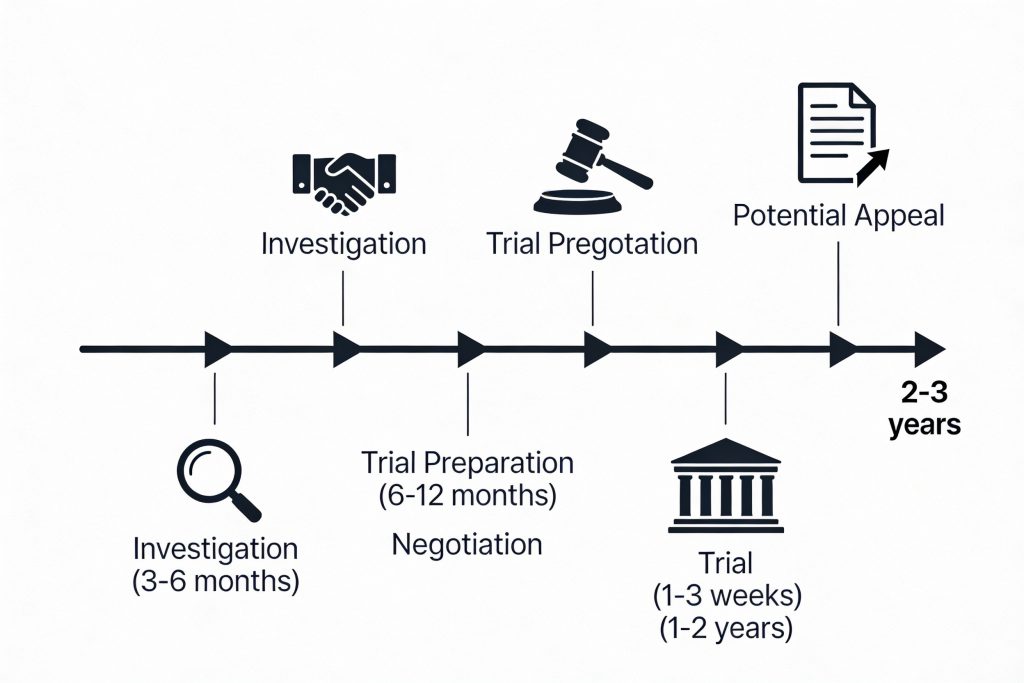
Medical malpractice cases typically take 2-3 years to resolve from initial complaint to settlement or verdict. This timeline is driven by:
- Investigation Period (3-6 months): Both sides conduct discovery, obtain expert opinions, and request medical records
- Negotiation Period (6-12 months): Settlement discussions occur as both sides’ understanding of case value develops
- Trial Preparation (6-12 months): Cases going to trial require extensive pretrial motions and witness preparation
- Trial (1-3 weeks): Actual court proceedings
Longer litigation timelines can increase settlement values because:
- Defendants face accumulating legal costs
- Insurance companies prefer resolution to ongoing uncertainty
- Emotional toll on involved parties increases settlement pressure
- Medical expenses continue accumulating, increasing damages
Impact of Mediation and Settlement Conferences
Many cases resolve through court-ordered or voluntary mediation before trial. Mediation can:
- Increase Settlements: Neutral mediator helps parties see realistic case value, often pushing settlements closer to full damages
- Decrease Settlements: If defendants’ side presents strong defense, plaintiff expectations may be adjusted downward
- Accelerate Resolution: Mediation often resolves cases 6-12 months faster than trial path
Appeal Outcomes
Appellate courts can modify verdicts:
- Verdict Reduction: Appeals courts sometimes reduce jury awards deemed excessive, typically by 10-30%
- Verdict Reversal: Appeals can result in complete reversal and retrial if procedural errors occurred
- Appellate Delay: Appeals extend total timeline 1-2 additional years, during which settlement funds are withheld
National Trends and Future Projections
Recent Trends (2020-2026)
Medical malpractice payouts have shown notable trends in recent years:
Rising Settlements: The national average has increased from approximately $330,000 in 2017 to $425,000-$450,000 in 2025-2026, representing a roughly 35% increase over 8 years.
Increased Claims Volume: The number of reported claims has grown, with 11,440 claims in 2023 and over 4,670 new claims reported by mid-2024, suggesting an annual pace exceeding 9,000 claims.
Higher Jury Awards: When cases go to trial, jury awards have increased faster than settlement amounts, with winning plaintiffs now averaging closer to $1 million or more.
Catastrophic Case Growth: The proportion of mega-settlements ($1 million+) has increased, though the percentage of total cases in this category remains around 10-15%.
Factors Driving Increases
Several factors explain rising malpractice payouts:
- Healthcare Costs: Medical inflation has increased the cost of future care, directly increasing damages calculations
- Increased Awareness: Patients and attorneys understand medical negligence rights better, leading to more claims
- Documentation Improvements: Better medical records make negligence clearer, increasing settlement pressure
- Jury Attitudes: Juries increasingly hold healthcare providers accountable, particularly for preventable errors
- Technological Advances: New diagnostic technologies make failure to diagnose clearer violations of standard care
Future Projections
Experts expect medical malpractice payouts to continue rising, with projections suggesting:
- 2026-2027: Average settlements reaching $450,000-$475,000
- By 2030: Potential for national average approaching $500,000 as healthcare costs continue rising and jurors increasingly hold providers accountable
- Regional Variation: Disparities between high-payout and low-payout states may narrow as standardized practices spread
The Cost Beyond Payouts
Understanding malpractice payouts requires recognizing costs beyond settlement amounts:
For Patients
- Legal Fees: Contingency-fee attorneys typically take 25-40% of settlements
- Court Costs: Filing fees, expert witness fees ($1,000-$10,000+ per expert)
- Deductibles and Co-pays: Additional medical expenses during litigation
- Time and Emotional Cost: Years of litigation causing ongoing stress
- Lost Income: Inability to work during extended recovery and litigation
For Healthcare Providers
- Insurance Premiums: Malpractice insurance costs increase after claims (typically 10-30% increases)
- Reputation Damage: Professional reputation and patient trust affected
- Lost Practice Time: Time involved in litigation and depositions
- Career Impact: Potential loss of hospital privileges or practice limitations
For Healthcare System
- Defensive Medicine: Increased testing and procedures to avoid litigation exposure (estimated cost: $50-100 billion annually)
- Insurance Costs: Healthcare system-wide insurance premiums increase
- Access Issues: Some specialists and rural practitioners limit services or relocate due to malpractice costs
- Innovation Delays: Defensive practices sometimes discourage adoption of new, potentially beneficial procedures
Navigating Malpractice Claims: What Patients Should Know
For patients considering medical malpractice litigation, understanding payouts is essential but incomplete:
When to Pursue a Claim
Not every negative medical outcome represents malpractice. Pursue a claim if:
- Medical professional’s actions deviated from standard of care expected in their specialty
- The deviation directly caused injury that wouldn’t have occurred with proper care
- Measurable damages exist (physical injury, lost wages, medical expenses)
- Evidence clearly documents the negligence
Finding Quality Legal Representation
The quality of your attorney significantly impacts settlement value:
- Specialization: Choose attorneys specializing in medical malpractice, not general practitioners
- Track Record: Research their success rate and average settlements
- Expert Network: Quality attorneys have established relationships with credible medical experts
- Communication: Ensure your attorney clearly explains your case value and litigation strategy
Understanding Settlement Offers
When receiving settlement offers:
- Request Justification: Ask how the offer was calculated; understand what factors influenced it
- Obtain Second Opinion: Have your attorney review offers from another qualified malpractice attorney
- Consider Liability Risk: Evaluate the strength of your case objectively; conservative settlement may be wise if liability is disputed
- Think Long-term: For permanent injuries, consider structured settlements ensuring ongoing resources
The Statute of Limitations Matters
Each state sets time limits for filing malpractice claims:
- Typical Range: 1-3 years from discovery of injury
- Discovery Rule: Clock often starts when injury is discovered, not when it occurred
- Tolling: Some circumstances extend deadlines (mental incapacity, minority age)
- State Variations: Large differences exist; consult an attorney in your state immediately if considering a claim
Conclusion
The average payout for a malpractice lawsuit in the United States varies considerably but centers around $348,000 to $450,000 as of 2025-2026, with a median settlement typically between $250,000 and $750,000. However, this average obscures tremendous variation driven by injury severity, jurisdiction, type of medical error, and numerous other factors.
Settlements resulting in death average approximately $380,300, while catastrophic injuries can reach $19.5 million to $27.5 million. Trial verdicts average approximately $1 million when plaintiffs prevail, though defendants win 80-90% of cases that proceed to trial, making settlement the more reliable outcome.
Geographic variation is substantial: South Dakota and Wyoming report the highest average payouts (approaching $1-2 million), while Vermont and Texas report the lowest (under $250,000 in many cases). These disparities reflect state tort law, damage caps, jury attitudes, and healthcare system characteristics.
For patients considering medical malpractice claims, understanding that “average” is merely a statistical midpoint is essential. Your case’s value depends on specific circumstances, the strength of evidence, your jurisdiction, and the quality of legal representation you obtain. Consulting with a qualified medical malpractice attorney in your state can provide a realistic assessment of your particular case’s potential value.
As healthcare costs continue rising and patients become increasingly aware of their rights, medical malpractice payouts will likely continue increasing. However, substantial variation will persist, ensuring that each case must be evaluated individually rather than relying on national averages.


